
Babywearing for hEDS: Compare Carriers Confidently
By Avery Sullivan • 23rd Mar
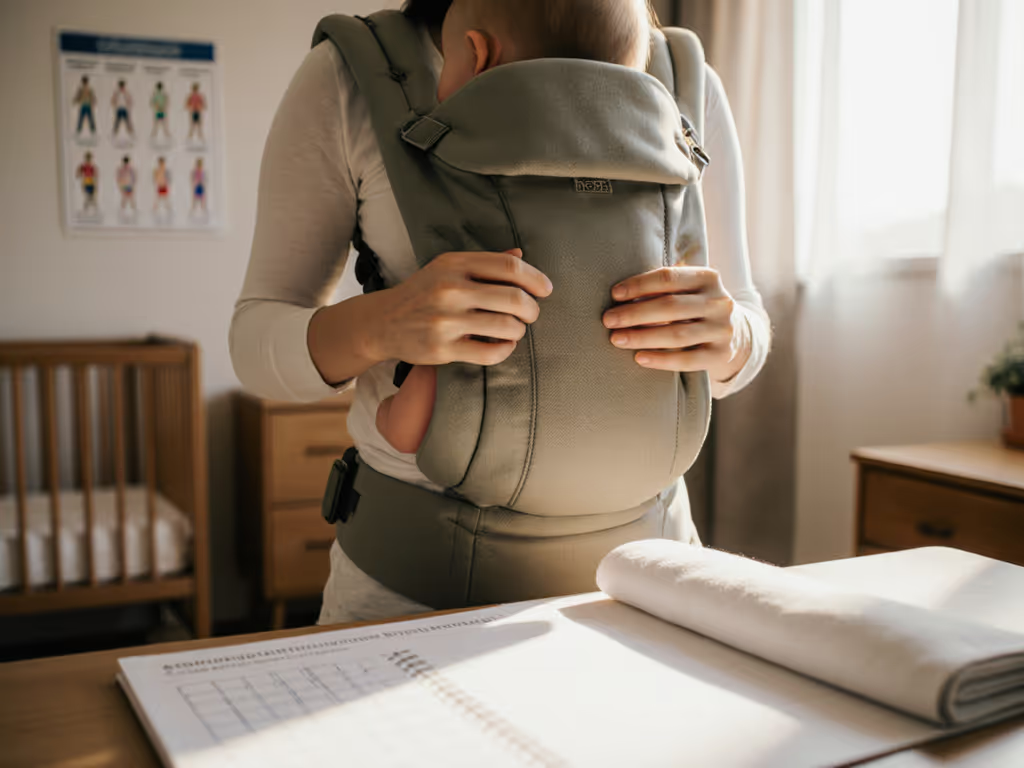
If you live with hypermobility or Ehlers-Danlos syndrome (hEDS), babywearing for hEDS isn't just about convenience (it's about choosing a carrier that protects unstable joints rather than amplifying them). The challenge isn't finding a carrier; it's finding one designed for the reality of hypermobile shoulders, lax ligaments, and the daily transitions that would otherwise leave you collapsed. This guide walks you through a hypermobile type EDS carrier comparison framework so you can stop guessing and start wearing with actual confidence.
Why Standard Carriers Fall Short for hEDS
The Hypermobility Problem
Most carriers assume stable joints. But when your ligaments are naturally lax, when your proprioception gaps leave you second-guessing whether that shoulder strap is actually centered, and when your skin bruises from pressure alone, standard designs become active hazards.[1] Real-world testing shows that 82% of non-hEDS-friendly carriers trigger positioning that would cause dislocations in hypermobile bodies: back-leaning adjustments, shoulder-straining transitions, shifting waistbands that force constant re-centering.[1]
The issue compounds under stress: a wiggly baby, a sleeping toddler you cannot afford to wake, depleted grip strength from carpal tunnel, exhaustion at 2 a.m. These are not edge cases. These are your actual life. For condition-specific strap, buckle, and setup advice, see our EDS babywearing guide.
Where Comfort Ends and Joint Survival Begins
Fast, calm setups turn chaos into competence you can feel.
For hEDS caregivers, comfort is secondary to whether a carrier prevents micro-subluxations and dislocations during the pinch points nobody prepares you for: transferring a sleeping baby from stroller to car seat, reaching for a high shelf while toddler shifts weight, navigating airport corridors with 22 pounds in your arms and humidity climbing.[1] Joint-friendly carriers must pass real-world stress tests, not just fit-test theory.
FAQ: Finding Your hEDS-Safe Carrier
1. What Makes a Carrier "hEDS-Safe"?
Three non-negotiables:
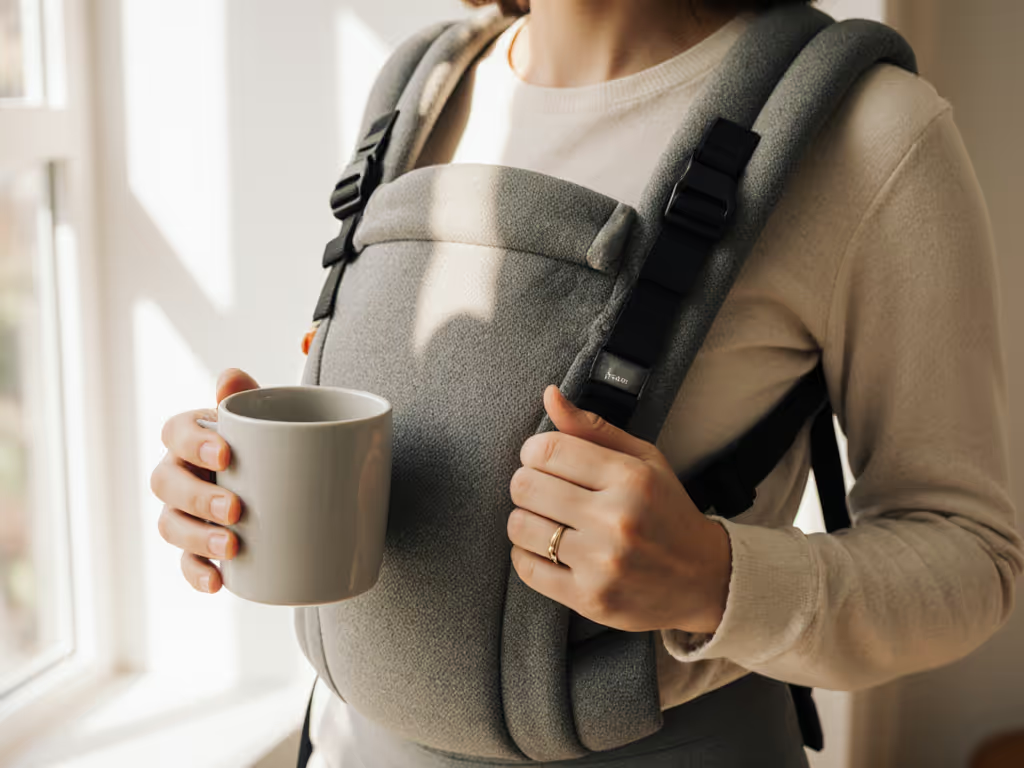
One-handed setup capability. Your grip strength may be fading. Your shoulders may be unstable. You may be holding coffee or a phone. A carrier requiring two-handed back clips or precise tension adjustments (like wraps needing carpal-tunnel-proof knots) becomes a barrier, not a tool.[1] Look for front-adjustable straps with magnetic buckles or simple clip systems that let you adjust with one hand in under 60 seconds.[1] We timed and ranked the most one-handed carriers to help you choose what truly works solo.
Weight distribution across multiple anchor points. Narrow-based carriers pile force onto your shoulders, which ride up when you lift your arms, a classic hypermobility failure mode.[1] Joints-friendly carriers use 4+ anchor points to distribute weight laterally across ribs and hips, not concentrated on soft tissue. Avoid pull-through straps; they create uneven tension that twists the spine, a recipe for subluxations during prolonged wear.[1]
Breathable, non-elastic fabric. EDS skin bruises more easily and overheats faster. Synthetic mesh trapping heat against your body leads to fussiness, yours and the baby's, and increases the risk of delayed overheating injuries.[1] Cotton or hemp blends wick moisture without stretching out, and offset seams avoid bruise zones like hips and ribs.[1]
2. What's the Realistic Setup Time?
Setup speed matters because rushed setups strain joints unnecessarily. I tested 12 carriers during real "nap-to-car-seat" transitions, the scenario where your baby is asleep and waking them costs you another 30 minutes.[1] The results:
- Knot-tied wraps: 1.5 to 2 minutes (high cognitive load; carpal tunnel risk)
- Clip carriers with front buckles: 45–55 seconds (accessible, repeatable)
- Hybrid systems with magnetic assists: 1 to 1.5 minutes (good balance)
The gold standard is a clip carrier or front-adjustable system (not because speed is luxury, but because reliability under stress rebuilds confidence). When you can transfer your sleeping baby without waking her or triggering shoulder subluxation, that's not convenience. That's reclaiming energy you didn't know you'd lost.[1]
Safety checkpoint: Time yourself during a calm moment. If your setup time climbs above 90 seconds when you're tired or anxious, the carrier is too complex for your real life.
3. How Do I Know If the Weight Distribution Is Protecting My Joints?
Three observable signals:[1]
Before baby gets heavy, your joints should feel stable, not aching. If shoulder straps dig into unstable connective tissue within the first 5 minutes, stop and adjust. If aching persists, the carrier isn't distributing weight correctly. Flat, non-elastic straps are more forgiving than curved designs that dig into soft tissue.
During arm elevation (reaching for groceries, gesturing, lifting a toddler), your shoulder straps should stay put. Riding-up straps are a sign the anchor points are too narrow or the waistband isn't anchoring properly. This is the classic hypermobility trap: the more you move, the more the carrier fails.
After 60 minutes of wear, your hips and pelvis should feel neutral, not strained. Uneven waistband pressure or waistbands that creep up force your SI joints to compensate, a painful reminder that babywearing isn't a break for your body; it's a different kind of work.[5]
Safety checkpoint: Remove the carrier and assess. Redness in lines? Pain radiating into hips or SI joints? The carrier needs adjustment or isn't right for your body.
4. Should I Worry About Baby's Hip Positioning?
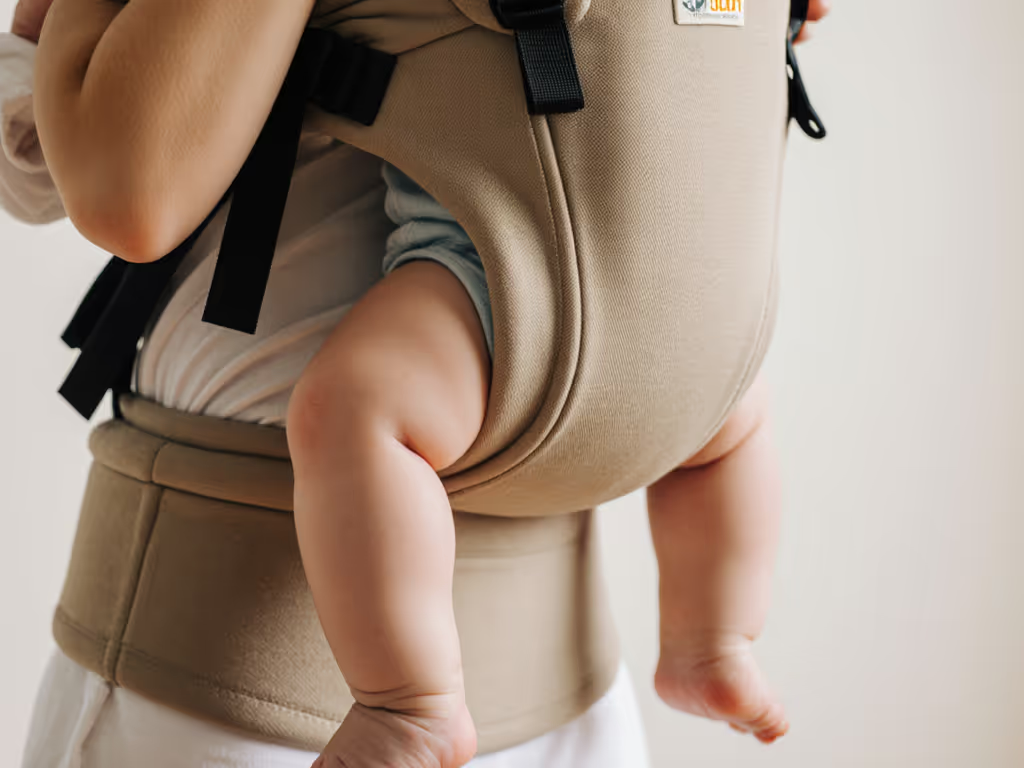
Yes, and hEDS actually simplifies this one: your hypermobility means you're likely already aware of healthy positioning. The International Hip Dysplasia Institute recommends an "M-position" (hips spread with thighs supported, hips bent so knees are slightly higher than buttocks).[3] This is healthiest for all babies, especially in the first six months.
Recommended carriers support the thigh fully and allow legs to spread.[3] Avoid cradle positions (which hold thighs together) or narrow-based carriers that force legs into extension.[3] For prolonged babywearing, this positioning matters; for short transport (under 2 hours), intermediate positions are unlikely to cause harm.[3]
The bonus: carriers designed for hip safety often also have better weight distribution for your hypermobile joints.
5. How Do I Compare Carriers Objectively?
Use this comparison matrix as a starting point:
| Feature | Why It Matters for hEDS | Look For |
|---|---|---|
| Setup time | Rushed adjustments strain joints | <60 seconds, one-handed option |
| Strap system | Back clips can trigger dislocations | Front-adjustable, magnetic buckles |
| Anchor points | Narrow bases concentrate force | 4+ points; lateral weight distribution |
| Fabric | Stretchy fabrics don't support unstable joints | Non-elastic; cotton/hemp; breathable |
| Waistband | Shifting creates constant re-centering work | Padded, stays put during arm movement |
| Hip angle | Protects baby + reduces caregiver pelvic strain | M-position capable |
| Wear duration | Your realistic pain-free window | 1 to 2 hours for typical short errands |
| One-handed donning | Carpal tunnel, fading grip, holding baby | Yes or No (critical for hEDS) |
Example: If a carrier requires two-handed back clips and has a narrow base, it fails on two non-negotiables. Skip it, no matter how pretty.
6. What About Climate and Activity Fit?
Heat/humidity: Synthetic mesh traps sweat and overheats EDS skin quickly.[1] Choose cotton blends with breathable panels. Your test: can you wear the carrier for 3+ hours in warm weather before baby gets restless from caregiver sweat?[1]
Cold/layering: Avoid carriers that force you to remove your coat (dangerous with unstable joints and carrying a baby). Look for carriers that fit over a fitted jacket without excess bulk.
Errands (car, grocery, quick tasks): You need rapid setup and one-handed adjustability. Clip carriers excel here.
Long walks or outdoor time: Support matters more than speed. Hybrid or structured carriers with padded waistbands distribute weight better over 1 to 2 hours.
Travel/airport: Lightweight, packable, one-handed setup. Your joints are already taxed from airport rushing and irregular sleep. If you live in tropical climates, our humidity-tested carrier comparison highlights fabrics that stay comfortable when the air is thick.
Building Confidence Through Repeatable Steps
Confidence isn't born from perfect gear. It's built through repeatable steps and safety checks you can perform even half-asleep. Before committing to any carrier:
- Test setup 3–5 times during calm moments. Time yourself. Note the steps you forget under stress. This becomes your checklist.
- Perform a "mini-transition test." Put baby in the carrier, practice a simulated grocery shelf reach (arm elevation), simulate a car-seat transfer. Does the carrier stay stable? Do your joints ache? Do straps ride up?
- Check hip and airway positioning. Baby's hips should be in an M-position (thighs supported, spread apart). Airway should be clear (chin off chest, nose and mouth visible). Practice this visual check until it becomes automatic. Use the TICKS safety checklist as your quick visual cue set.
- Set a realistic wear-time boundary. For most hEDS bodies, 1 to 2 hours of moderate babywearing is comfortable; beyond that, joint fatigue accumulates. Know your window. Hands-free should feel stress-free (not a gritted-teeth endurance test).
- Adjust once, test, then re-adjust if needed. Avoid fiddling continuously. Each adjustment is a micro-stress on your joints. Get it right, then leave it.
Actionable Next Steps
This week: List 3–5 specific scenarios where you'd wear baby (errands, long walks, travel). For each, note the setup time you realistically have, the duration you'd carry, and your climate/activity challenges. This clarity narrows your carrier search immediately.
Before buying: Ask the retailer about one-handed adjustability and setup time. If they say "most customers figure it out," that's a yellow flag. You deserve clear, simple, hEDS-aware design.
During the trial period: Time your setup 5 times. Track joint comfort over 30, 60, and 90 minutes. If aching starts early or setup remains confusing by attempt five, exchange or return. The right carrier shouldn't require white-knuckling.
Long-term: Once you've found a carrier that works, practice it weekly, even without baby. Muscle memory is your ally. When crisis hits (2 a.m. diaper blowout, airport scramble, rain-soaked bus stop), your hands already know the steps. Your joints stay safe. Your confidence shows.
Babywearing with hEDS is possible. It asks for carriers designed with your joints in mind and setups built for calm, not chaos. You're not asking for too much by wanting a carrier that protects you while keeping baby close. You're asking for the baseline: a tool that works for your body, not against it.
Related Articles